Thursday, 19 June 2008
Trend Report: Architecture In Fashion
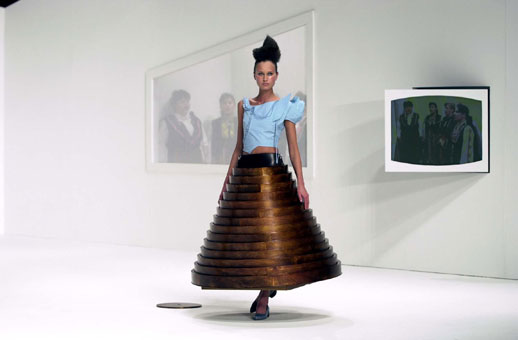
There is an inextricable link between fashion and architecture. Time and again we see comparable themes reflected in both clothing and buildings, but primarily their fundamental function is to provide shelter to the individual. Rather amusingly at Beaux Art Costume in 1931, New York’s architects decided to transcend the line between the two and dressed in sculptural forms of skyscrapers that represented the buildings that they in fact designed themselves. Lines, shape and structure are clearly apparent in both mediums and understandably as individual entities, they become a source of inspiration. The recent ‘Skin and Bones’ exhibition at Somerset House in London explores how these different disciplines have become blurred. It introduces general themes of identity, body and shelter which are represented by visual displays that illustrate the construction techniques applied to both in creating their structural skin. Most notable is Hussein Chalayan’s ‘Afterwords’ collection from 2000 where by garments transformed into wearable living-room furniture. His theme of migration and misplaced refuge was illustrated in collapsible three-dimensional furnishings that converted into skirts and dresses allowing the individual to leave one’s home at a moment’s notice. Advancement in technology and construction have not only allowed fashion designers to push their artistic boundaries, but similarly architects have been able to adopt techniques such as pleating, draping, folding and printing that have previously only been synonymous with fashion. These skills are largely predominant in Japanese designers work. Commes des Garcons and Issey Miyake continually push the boundaries and explore new ways to exploit the silhouette through highly developed techno fabrics and innovative approaches in construction. The clothing featured in “Skin and Bones” are noticeably reflective of architectural construction as they both commandeer the human body as a site. Albeit overstated, the exhibition uncovers a formidable relationship between the two disciplines that is not only reflected in garment construction but can also be mirrored in shoe design. During Colin McDowell’s recent interview with Manolo Blahnik at the London College of Fashion, Blahnik revealed that his main source of inspiration was found in the “lines” of architectural structures. Ancient and modern buildings provide a source of stimulation for designers by their simple linear construction. In the same way, the scope and magnitude of buildings encourages designers to metamorphosize the silhouette into voluminous matter. Coco Chanel was famously quoted as stating that, “Fashion is architecture; it is a matter of proportions”. Although, this was assumed many years ago, it is still very relative to today. Both disciplines transform two-dimensional shapes into a three-dimensional structure. The continual advancement of technology in architecture undoubtedly suggests that fashion itself, will have new and unusual ways of encasing our skin and bones in the near future.


Iconic Fashion Moment In Cinema
Woody Allen’s 1977 cult movie Annie Hall reintroduced the boyish look that Marlene Dietrich initiated in the 1930’s. This bittersweet romantic comedy centralises around the comedian Alvy Singer’s relationship with the endearing Annie Hall which was memorably played by the actress Diane Keaton. Her unconventional style combined voluminous tailored trousers with oversized shirts and cropped suiting jackets which transformed the silhouette into a mixture of soft curves and hard tailoring. For the most part, the Annie Hall look exudes boyish charm. Keaton, known for her tom-boyish dress sense, was perfectly suited for the role and unsurprisingly a lot of the clothes featured in the film were in fact Keaton’s own. The amalgamation of brown oversized chinos worn with loose fitting shirts that were completely buttoned to the collar, teamed with patterned ties, wool waistcoats and floppy bowler hats were for the most part eccentric. In spite of that, the look had an essence of femininity that was created through silk scarves that were draped around the neck combined with high-waisted trousers that cinched in around the stomach. Shortly after the film’s release, women began wearing men’s clothing and trouser suits. Without a doubt the retail industry had lucratively adopted the Annie Hall look from the big screen and effectively translated it to the high-street. For a woman to wear a man-style suit is seen to be empowering. Even today the androgynous look is still as dominant and fashion forward as it was in the 1930’s. Designers, such as Margaret Howell have successfully generated this style for years. Undeniably, Annie Hall is notably an iconic film of both cinematic and fashion history and is still inspiring designers today.
Mert And Marcus
The Dubai desert is the back drop for Louis Vuitton’s Spring Summer 2004 advertising campaign. A sun drenched beauty outstretched in a provocative manner, sexually charged with arms extended. Eyes open, she stares intently upwards at the brilliant blue sky with a sense of wanting. The evocative front opening of the plunge-neck dress reveals more of her irresistible sun-kissed skin. In pastel lemon, the bottom-skimming dress is encapsulated in a luminous yellow sash accentuating the womanly shape of an hour glass figure. Here lies a powerful yet seductive beauty, one where the subtlety of a handbag hangs loosely over her wrist becoming an extension of the girl herself. The bag’s absence of vivid colours is nevertheless identifiable by the infamous repetitive pattern of the Louis Vuitton logo and the notorious use of a solid gold lock. Mert and Marcus’s use of colours ignite the imagination. The often overlooked shades of browns are accentuated in her flawless gloss skin and the perfectly sculpted sand dunes. Hot pink is used sparingly as a highlight on her polished fingernails alluding to hidden promiscuity and mischievousness. The rich azure blue is a backdrop and used as an accent in emphasising the effect of illusion. This disconnected sense of reality is created through photographic enhancement of stark contrasts and rich colours. The desert goddess is seemingly super imposed onto a dream like setting. The painterly quality of this image fashions an unapologetic perfection, one where their photographic subject becomes magnificent and idealistic through manipulation and airbrushing techniques. This image contains many of the attributes associated with the duo’s distinctive style. Their fascination with strong and powerful women is apparent. They create a look of absolute perfection through seductive colours and a digitized glaze. Understandably, Mert and Marcus’s provocative and individual style has restored glamour to photography.


The Swedish And The Japanese Unite: The Next Collaboration To Look Out For.
Fashion chain giants, H & M have welcomed their newest recruit Rei Kawakubo, for an inspired capsule collection to hit the shops world wide later this year. Born in Tokyo in 1942, Rei Kawakubo is notably the designer’s designer. Her company ‘Commes des Garcons’ was founded in 1973 and literally translates from French to mean ‘like the boys’. This philosophy is reflected in her garment construction and overall style of the label. Kawakubo’s elusive nature has perhaps, at times, benefited her garment technology ethos. A woman of few words and who rarely gives interviews has created a language through clothes by merely suggesting that the garments speak for themselves. But how will this translate to the high street? Her anti fashion approach to design and deconstructive manner have inspired and influenced the world over however, at a price. A shrewd businesswoman, the Japanese designer has blurred the lines of fashion and art culture through her clothes, shops and even her perfume. Her inspired ‘Red’ shop in Paris and more famously her London store, Dover Street Market have successfully transgressed the medium of fashion with art in order to enhance people’s shopping experience. So why would Kawakubo join forces with the Swedish fashion chain that has become synonymous with disposable trends? Two words, business sense. Kawakubo has always understood the importance between business and creation and this new collaboration with H & M will do just that. It will allow the average person to afford the unaffordable. But more importantly, what should we expect from the design? As a rule, Kawakubo challenges the preconceptions of what is deemed sexy by means of oversized androgynous silhouettes combined with serious colours, more commonly black and worn with flat genderless shoes. All this being said, it is set to be a fascinating collaboration. The collection will consist of a women’s and menswear collection alongside accessories and an exclusive unisex fragrance later in Autumn this year. A definite must see.
Subscribe to:
Posts (Atom)